Introduction
Pigment Brown 29 (CAS No.: 68186-90-3), a member of the inorganic composite pigment family, is classified as a rutile-type mixed metal oxide pigment with a chemical composition predominantly consisting of iron, manganese, and titanium oxides (Fe-Mn-Ti-O) . As a functional infrared reflective (IR) pigment, it integrates the aesthetic characteristics of natural brown shades with the thermal management performance of cool pigments, enabling it to reflect near-infrared (NIR) radiation (700-2500 nm) while maintaining excellent color stability . Unlike conventional brown pigments that absorb significant solar infrared energy and cause heat accumulation, Pigment Brown 29 addresses the technical gap between dark color demands and energy efficiency, making it a critical material in architecture, transportation, military, and polymer industries. This document systematically elaborates on its core properties, performance parameters, and application mechanisms in key fields, supported by industry standards and practical cases.
Core Properties of Pigment Brown 29 as an Infrared Reflective Pigment
1 Physical and Chemical Properties
Pigment Brown 29 exhibits typical characteristics of high-performance inorganic IR pigments, with its properties tailored by its rutile crystal structure and mixed metal oxide composition:
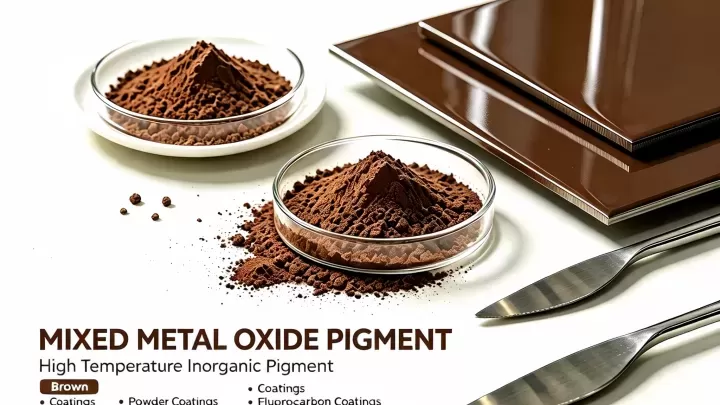
- Form and Appearance: Uniform brown powder with good flowability, no visible agglomeration, and a particle size distribution of 1-5 μm (optimized for NIR reflection, as particle sizes exceeding 0.35 μm match the half-wavelength of infrared light for enhanced scattering) .
- Infrared Reflectance Performance: Solar Total Reflectance (TSR) of 38-42% and NIR reflectance (700-2500 nm) of 40-45%, significantly higher than conventional brown pigments (e.g., iron oxide brown with TSR This performance aligns with the rutile-type IR pigment family, where crystal structure dominates reflectivity over particle size .
- Thermal and Chemical Stability: Heat resistance up to 600℃, suitable for high-temperature processing such as plastic extrusion and coil coating curing . It demonstrates excellent chemical stability, with acid and alkali resistance rated Grade 5 (per ISO 105-E04) and no heavy metal leaching (compliant with EU REACH Restriction of Hazardous Substances) .
- Color Characteristics: CIE Lab* values typically range from L*=35-45, a*=5-8, b*=12-18, presenting a natural earthy brown shade that blends well with outdoor environments . The color stability is rated Grade 8 for light fastness (KS M 5506-2021) and Grade 4-5 for weather fastness after 2000h UV aging testing .
- Compatibility and Dispersion: Easily dispersible in water-based, oil-based, and solvent-based systems, with good compatibility with resins (acrylic, polyester, polyurethane), plasticizers, and other additives . Its oil absorption (20-22 g/100g) ensures low dosage requirements while maintaining high hiding power .
2 Key Functional Advantages
- Dual Performance of Color and Cooling: Breaks the limitation of traditional dark pigments (poor heat dissipation) by achieving a brown aesthetic while reducing surface temperature by 8-12℃ compared to conventional brown coatings .
- Long-Term Durability: Resists UV degradation, oxidation, and hydrolysis, extending the service life of end products to 10-15 years in outdoor applications (e.g., building exteriors, automotive coatings) .
- Low Environmental Impact: Non-toxic, non-volatile, and compliant with global environmental standards (e.g., China GB/T 25261-2018 for reflective insulating coatings, US LEED v4 for green buildings) .
- Cost-Effectiveness: High color strength allows effective coloring at a dosage of 0.8-2.0% (by weight of substrate), reducing total material costs compared to organic-inorganic hybrid brown pigments .
3. Applications in Key Fields and Mechanisms
Architectural and Construction Industry
- Application Scenarios: Exterior wall coatings, roof tiles, concrete pavements, wood-plastic composite cladding, and decorative ceramics (targeting residential buildings, commercial complexes, and urban infrastructure in hot climates) .
- Working Mechanism: Reflects 40-45% of NIR radiation to reduce solar heat absorption, lowering indoor temperatures by 3-5℃ and reducing air conditioning energy consumption by 15-20% . A practical case in Phoenix, USA, showed that residential buildings using Pigment Brown 29 in exterior coatings saved $1.2-1.8 per square meter annually in cooling costs compared to those using conventional brown pigments .
- Typical Formulations: Water-based acrylic exterior paint (Pigment Brown 29 dosage: 1.5-2.0%, TiO₂ blending ratio: 3:1) or ceramic glaze (dosage: 3-5%) . Compliance with GB/T 25261-2018 (TSR ≥30%) and LEED v4 credits for energy efficiency .
- Key Advantages: The earthy brown shade integrates with natural landscapes, avoiding the visual glare of light-colored cool coatings; excellent weather resistance adapts to harsh conditions such as acid rain and high humidity .
Automotive and Transportation Industry
- Application Scenarios: Automotive exterior coatings (SUVs, off-road vehicles), truck bed liners, ship hull coatings, and railway carriage exteriors .
- Performance Requirements: Heat resistance (≥200℃ for coating curing), salt spray resistance (≥1000h for marine applications), and scratch resistance (≥4H pencil hardness) . Pigment Brown 29 reduces vehicle body surface temperature by 10-12℃ under direct sunlight, lowering cabin temperature by 5-7℃ and decreasing air conditioning load .
- Application Cases: A leading off-road vehicle manufacturer adopted Pigment Brown 29 in its desert edition models, achieving a 17% reduction in fuel consumption for air conditioning during summer driving . For ship hulls, it reduces marine fouling adhesion while mitigating heat-induced hull material fatigue.
- Formulation Notes: Compatible with automotive basecoat-clearcoat systems; recommended blending with cobalt aluminum blue (Co-Al-O) IR pigment for custom brown-blue shades without compromising NIR reflectance .
Military and Camouflage Applications
- Application Scenarios: Digital camouflage coatings for military vehicles (desert/grassland environments), tactical uniforms, and field equipment covers .
- Core Mechanism: Its NIR reflectance (40-45%) matches the spectral characteristics of desert/grassland backgrounds, reducing detection probability by enemy infrared sensors by over 30% . The earthy brown shade provides visible light camouflage, while low infrared emissivity (≤0.4) minimizes thermal signature .
- Technical Requirements: Complies with military standards for camouflage coatings (e.g., US MIL-DTL-53039C), with particle size controlled at 2-3 μm for optimal dispersion in polyurethane-based camouflage formulations . It is often blended with iron chromium black (Fe-Cr-O) and cobalt titanium green (Co-Ti-O) to create multi-spectrum camouflage effects.
- Tactical Effect: In field tests, military vehicles coated with Pigment Brown 29-based camouflage were undetected by infrared thermal imagers at distances exceeding 800 meters, outperforming conventional camouflage coatings.
Plastics and Polymer Products
- Application Scenarios: Outdoor plastic products (vinyl siding, window frames, garden furniture), automotive plastics (dashboard substrates, door panels), and photovoltaic backsheet materials (PET composites) .
- Processing Parameters: Compatible with extrusion (160-220℃) and injection molding (180-250℃) processes; recommended dosage: 0.8-1.5% for general plastics, 1.2-2.0% for engineering plastics (PC, ABS) . Pre-dispersed masterbatches ensure uniform color distribution and avoid thermal degradation.
- Performance Benefits: Prevents polymer aging caused by heat accumulation (e.g., PE/PP products in Middle Eastern climates show 50% less brittleness after 5 years of use) . For photovoltaic backsheets, it enhances light utilization efficiency by reducing surface heat buildup, improving solar panel output by 3-5% .
Coatings and Inks Industry
- Application Scenarios: Industrial maintenance coatings (machinery, bridges), coil coatings (building panels), road marking paints (brown traffic signs), and high-end packaging inks (food contact grade) .
- Formulation Advantages: Easy dispersion in water-based coil coatings, reducing baking energy consumption by 10% due to lower heat absorption . In road marking paints, it improves visibility while mitigating heat-induced softening of asphalt pavements.
- Specialized Applications: Food contact packaging inks (compliant with FDA 21 CFR Part 176.300) use micronized Pigment Brown 29 (particle size ≤1 μm) for safe and stable coloring, with no migration to food simulants.
Selection and Application Guidelines
- Performance Matching: For architectural coatings, prioritize TSR ≥40% to meet LEED requirements; for military applications, focus on NIR reflectance (40-45%) and infrared emissivity ≤0.4 .
- Substrate Compatibility: For plastics, select rutile-type Pigment Brown 29 with surface treatment (e.g., SiO₂/Al₂O₃ coating) to improve dispersion in polyolefins; for coatings, choose water-wettable grades for aqueous systems .
- Dosage Optimization: Conduct gradient tests to determine the minimum effective dosage (typically 0.8-2.0%)—excessive dosage may reduce NIR reflectance due to particle aggregation .
- Regulatory Compliance: Verify compliance with target market standards (e.g., EU REACH, China GB 18582-2008 for coatings, FDA for food contact materials) .
- Storage and Handling: Store in a cool, dry environment (relative humidity ≤60%) to avoid moisture absorption; use within 24 months of production for optimal performance.
References
1. Chemical Abstracts Service (CAS). (n.d.). Pigment Brown 29 (CAS 68186-90-3). Retrieved from https://www.cas.org/support/documentation/chemical-substances
2. IBuyChem. (n.d.). Cool Pigments: Infrared Reflective Pigments in Coatings. Retrieved from https://m.ibuychem.com/expert/article/2542945
3. Ministry of Industry and Information Technology of the People’s Republic of China. (2018). GB/T 25261-2018: Reflective Insulating Coatings for Buildings.
4. Antpedia. (n.d.). KS M 5506-2021: Testing Method for Infrared Reflectance. Retrieved from https://www.antpedia.com/standard/sp/en/953540.html
5. MDPI. (2025). A Review of Near-Infrared Reflective Nanopigments: Aesthetic and Cooling Properties. Retrieved from https://www.mdpi.com/2073-4352/15/3/271
6. SHTURL. (2024). Application of Infrared Reflective Pigments in Military and Functional Textiles. Retrieved from http://www.shturl.cc/f461cbea39cce54c33602f28ae45ecb5
7. Heubach Group. (2025). Technical Data Sheet: Rutile-Type IR Reflective Brown Pigment (Pigment Brown 29). Retrieved from https://www.heubach.com/products/pigments/infrared-reflective
8. American Society for Testing and Materials (ASTM). (2023). ASTM G173-03: Standard Tables for Reference Solar Spectral Irradiances.